
100 English Vocabulary Words to Use in Writing with Meanings
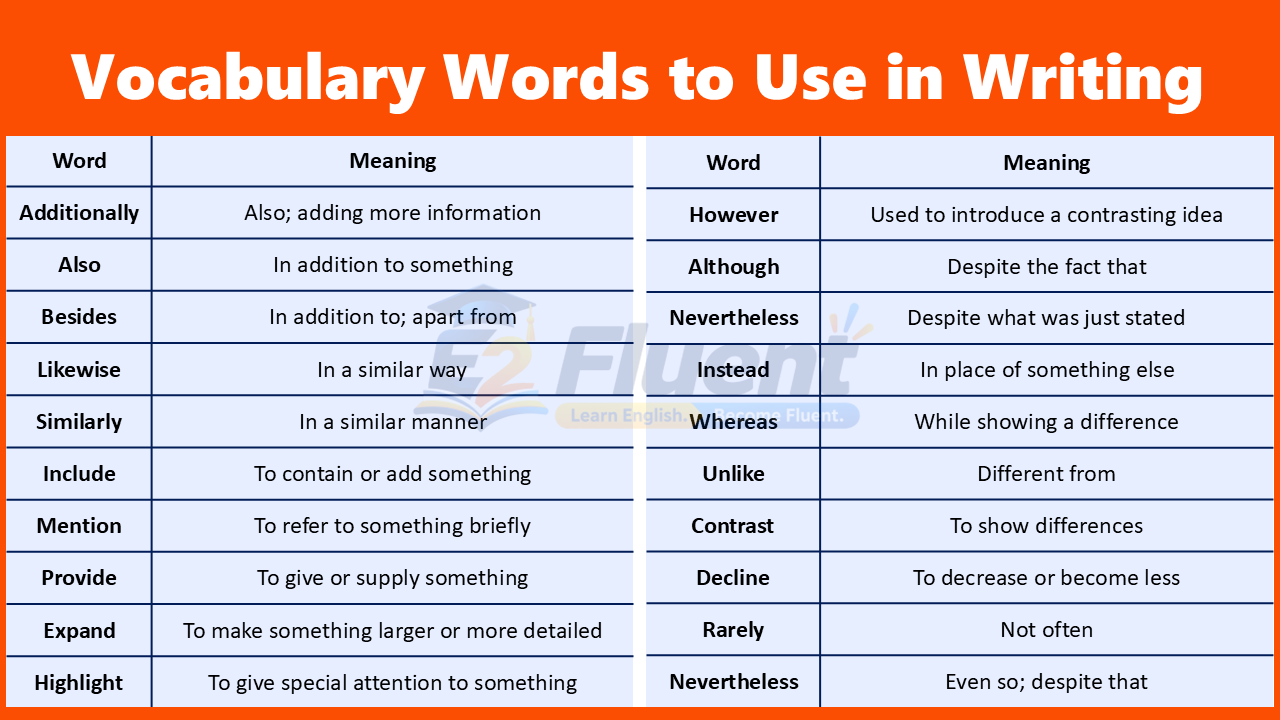
Good writing depends on choosing the right words. Vocabulary words to use in writing help you express ideas clearly, avoid repetition, and make your sentences more precise. Strong vocabulary is useful for essays, school assignments, paragraphs, stories, emails, and other forms of English writing. You do not need complicated words to write well. You need words that match your meaning and fit the context. This list includes 100 useful English vocabulary words with meanings and examples to help elementary to intermediate learners build stronger writing skills.
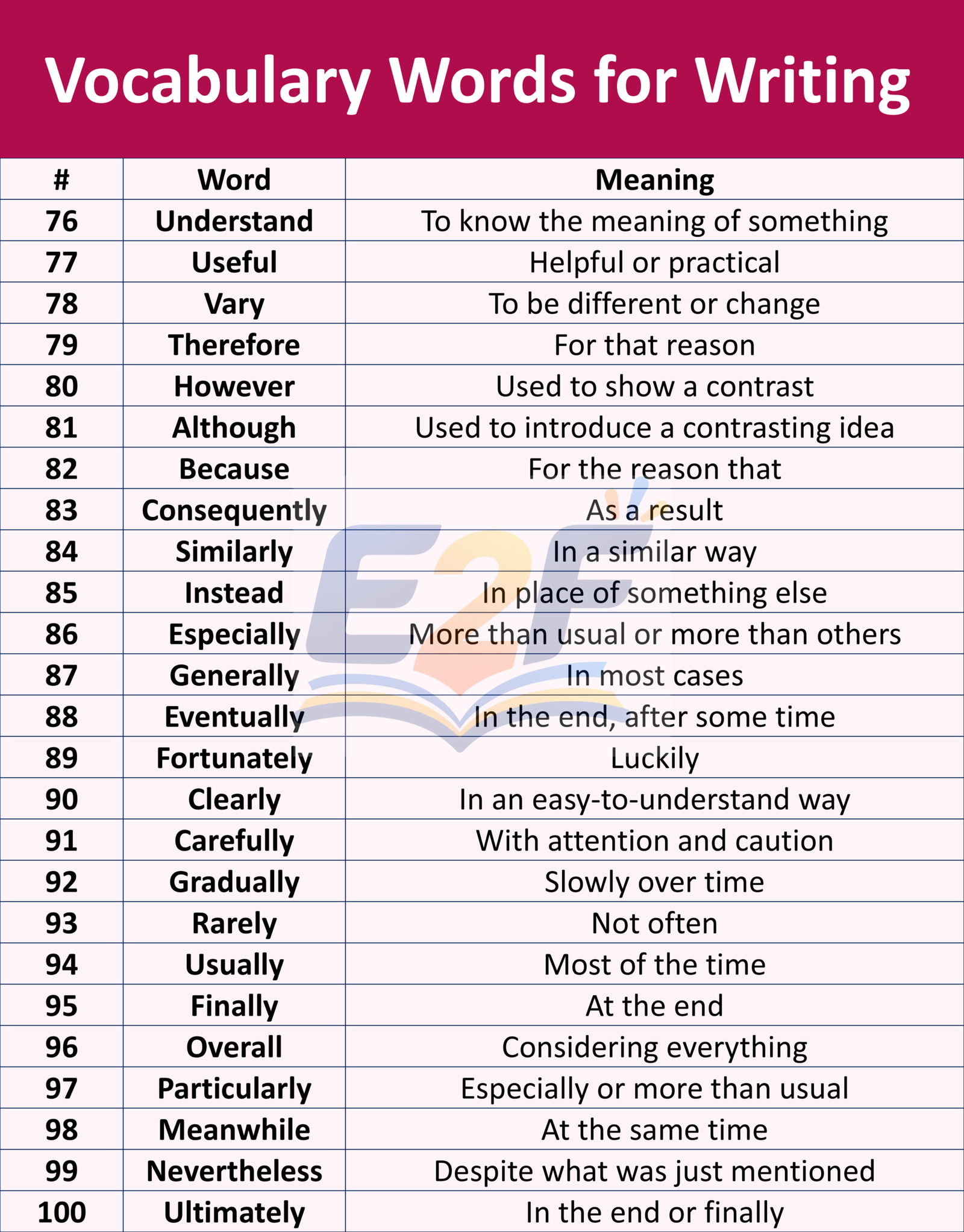
100 Vocabulary Words to Use in Writing with Meanings
These words can help with different types of writing. They can help you connect ideas, describe information, express opinions, explain reasons, and make your descriptions stronger.
Good Words for Adding Ideas and Information in Writing
These words help writers introduce another point, add supporting information, or connect related ideas naturally.
| # | Word | Meaning | Useful Sentence for Writing |
|---|---|---|---|
| 1 | Additionally | Also; adding more information | Additionally, regular reading helps students learn new sentence patterns. |
| 2 | Also | In addition to something | Reading also improves a learner’s understanding of grammar. |
| 3 | Besides | In addition to; apart from | Besides improving vocabulary, reading can develop writing skills. |
| 4 | Likewise | In a similar way | Likewise, younger students can benefit from regular writing practice. |
| 5 | Similarly | In a similar manner | Similarly, both studies found that practice improved performance. |
| 6 | Include | To contain or add something | A strong paragraph should include relevant supporting details. |
| 7 | Mention | To refer to something briefly | The writer mentions several benefits of learning another language. |
| 8 | Provide | To give or supply something | The article provides useful examples for English learners. |
| 9 | Expand | To make something larger or more detailed | Students can expand their ideas by adding specific examples. |
| 10 | Highlight | To give special attention to something | The final paragraph highlights the main benefits of the program. |
English Words for Showing Contrast in Writing
Contrast vocabulary helps readers understand differences between ideas, situations, people, or opinions.
| # | Word | Meaning | Useful Sentence for Writing |
|---|---|---|---|
| 11 | However | Used to introduce a contrasting idea | The method is useful; however, it may not work for every learner. |
| 12 | Although | Despite the fact that | Although the task was difficult, the students completed it successfully. |
| 13 | Nevertheless | Despite what was just stated | The first attempt was unsuccessful; nevertheless, the team continued. |
| 14 | Instead | In place of something else | Students should use clear language instead of unnecessarily difficult words. |
| 15 | Whereas | While showing a difference | Online classes offer flexibility, whereas classroom lessons provide direct interaction. |
| 16 | Unlike | Different from | Unlike formal writing, casual writing often uses shorter expressions. |
| 17 | Contrast | To show differences | The essay contrasts traditional education with online learning. |
| 18 | Decline | To decrease or become less | The report shows that attendance began to decline during the final weeks. |
| 19 | Rarely | Not often | Students rarely improve their writing without regular practice. |
| 20 | Nevertheless | Even so; despite that | The evidence was limited; nevertheless, it supported the main argument. |
English Vocabulary Words for Explaining Causes and Results in Writing
Cause-and-effect vocabulary makes it easier to explain why something happens and what happens because of it.
| # | Word | Meaning | Useful Sentence for Writing |
|---|---|---|---|
| 21 | Because | For the reason that | Many students read because they want to improve their vocabulary. |
| 22 | Therefore | For that reason | The evidence was limited; therefore, further research was needed. |
| 23 | Consequently | As a result | The road was damaged; consequently, transportation became difficult. |
| 24 | Prevent | To stop something from happening | Careful planning can prevent many common writing mistakes. |
| 25 | Impact | A strong effect on something | Technology has a significant impact on modern education. |
| 26 | Influence | The power to affect something | Family and teachers can influence a child’s reading habits. |
| 27 | Occur | To happen | Errors often occur when writers do not check their work. |
| 28 | Reduce | To make something smaller or less | Clear instructions can reduce confusion among students. |
| 29 | Benefit | A positive result or advantage | One benefit of reading is stronger vocabulary knowledge. |
| 30 | As a result | Because of something that happened | She practiced every day, and as a result, her writing improved. |
Vocabulary Words for Describing Ideas and Qualities in Writing
Precise descriptive words help writers explain the nature, quality, importance, or characteristics of an idea.
| # | Word | Meaning | Useful Sentence for Writing |
|---|---|---|---|
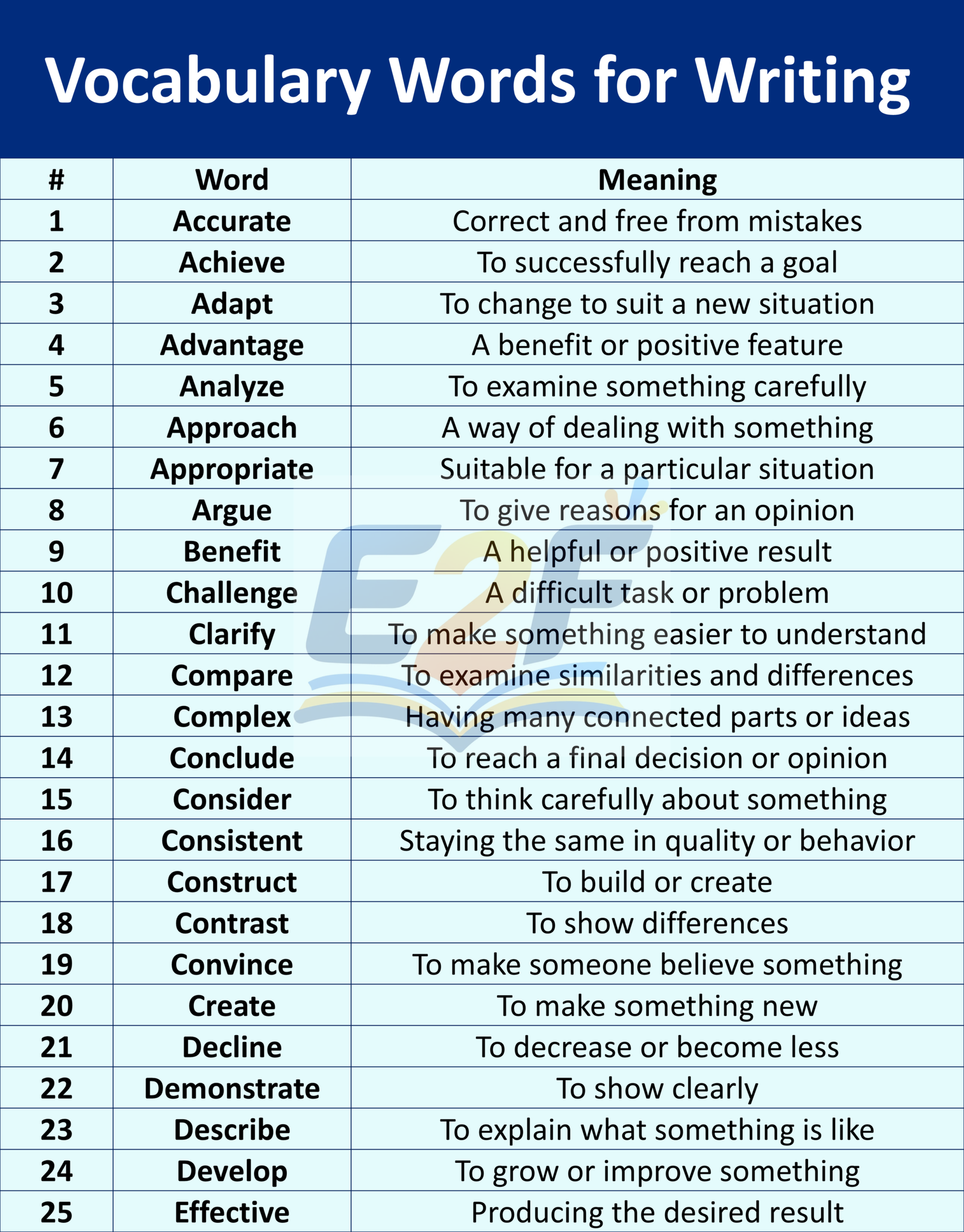
| 31 | Accurate | Correct and free from mistakes | Accurate information makes an article more trustworthy. |
| 32 | Appropriate | Suitable for a particular situation | Writers should choose appropriate vocabulary for their readers. |
| 33 | Complex | Having many connected parts or ideas | Pollution is a complex problem with several causes. |
| 34 | Effective | Producing the desired result | Regular feedback is an effective way to improve writing. |
| 35 | Flexible | Able to change when necessary | A flexible learning method can meet different student needs. |
| 36 | Relevant | Closely connected to the topic | Every example should be relevant to the main idea. |
| 37 | Significant | Important or noticeable | The study found a significant difference between the two groups. |
| 38 | Specific | Clearly defined or exact | Writers should use specific details instead of vague descriptions. |
| 39 | Positive | Good, helpful, or favorable | The students showed a positive response to the new activity. |
| 40 | Potential | Possible ability or possibility | The new program has the potential to improve reading skills. |
Words for Describing People and Actions in Writing
These words can make descriptions more precise, especially in personal essays, narratives, biographies, and school assignments.
| # | Word | Meaning | Useful Sentence for Writing |
|---|---|---|---|
| 41 | Responsible | Able to be trusted to do what is expected | A responsible student completes assignments on time. |
| 42 | Confident | Sure about your abilities or decisions | Regular practice can help learners become more confident writers. |
| 43 | Patient | Able to wait or deal with difficulty calmly | A patient teacher gives students enough time to develop their ideas. |
| 44 | Curious | Wanting to learn or know more | Curious students often ask questions that lead to deeper learning. |
| 45 | Generous | Willing to give or share | The generous volunteer donated books to the school library. |
| 46 | Determined | Strongly committed to achieving something | The determined student continued practicing despite several mistakes. |
| 47 | Creative | Able to produce original ideas | Creative writers often find unusual ways to present familiar ideas. |
| 48 | Reliable | Able to be trusted or depended on | A reliable source provides information that readers can verify. |
| 49 | Observe | To watch or examine carefully | Researchers observe changes before recording their findings. |
| 50 | Adapt | To change to suit a new situation | Good writers adapt their language to suit their audience. |
Vocabulary Words for Stronger Academic and School Writing
These words are particularly useful when explaining information, discussing evidence, analyzing ideas, and writing school assignments.
| # | Word | Meaning | Useful Sentence for Writing |
|---|---|---|---|
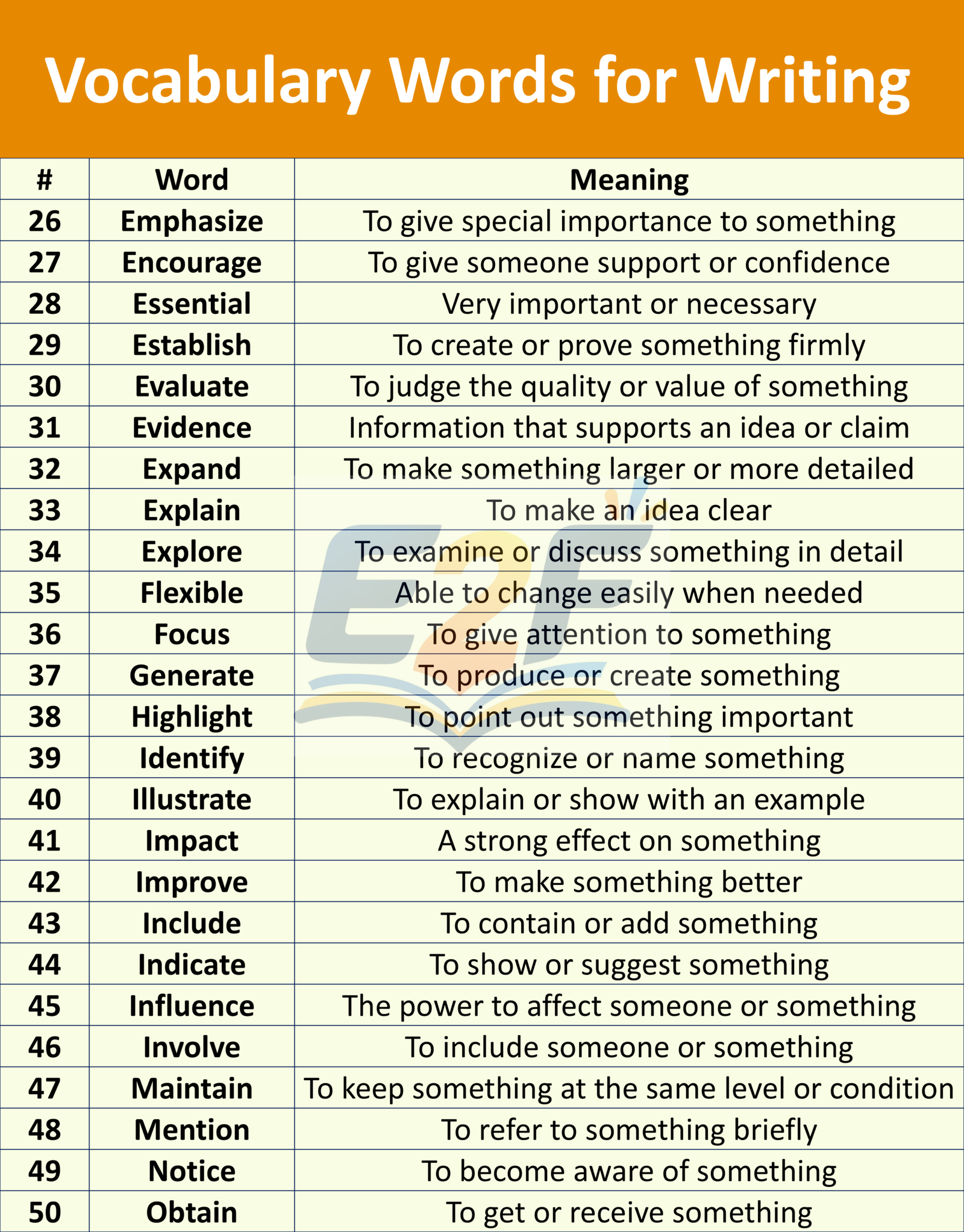
| 51 | Analyze | To examine something carefully | Students analyze the information before writing their conclusions. |
| 52 | Demonstrate | To show something clearly | The results demonstrate the value of regular practice. |
| 53 | Evaluate | To judge the quality or value of something | Students should evaluate the evidence before accepting the claim. |
| 54 | Identify | To recognize or name something | The writer identifies three major causes of the problem. |
| 55 | Illustrate | To explain something using an example | The example illustrates how small changes can improve writing. |
| 56 | Establish | To show or prove something clearly | The research establishes a connection between reading and vocabulary growth. |
| 57 | Construct | To build or create | Students must construct a clear argument using reliable evidence. |
| 58 | Develop | To grow, improve, or create | Writers develop stronger ideas when they support them with examples. |
| 59 | Explore | To examine or discuss something in detail | The essay explores the effects of social media on communication. |
| 60 | Indicate | To show or suggest something | The results indicate that regular practice improves performance. |
Words for Opinions and Arguments to Use in Writing
When writing an opinion paragraph or argumentative essay, your vocabulary should clearly show your position and the evidence behind it.
| # | Word | Meaning | Useful Sentence for Writing |
|---|---|---|---|
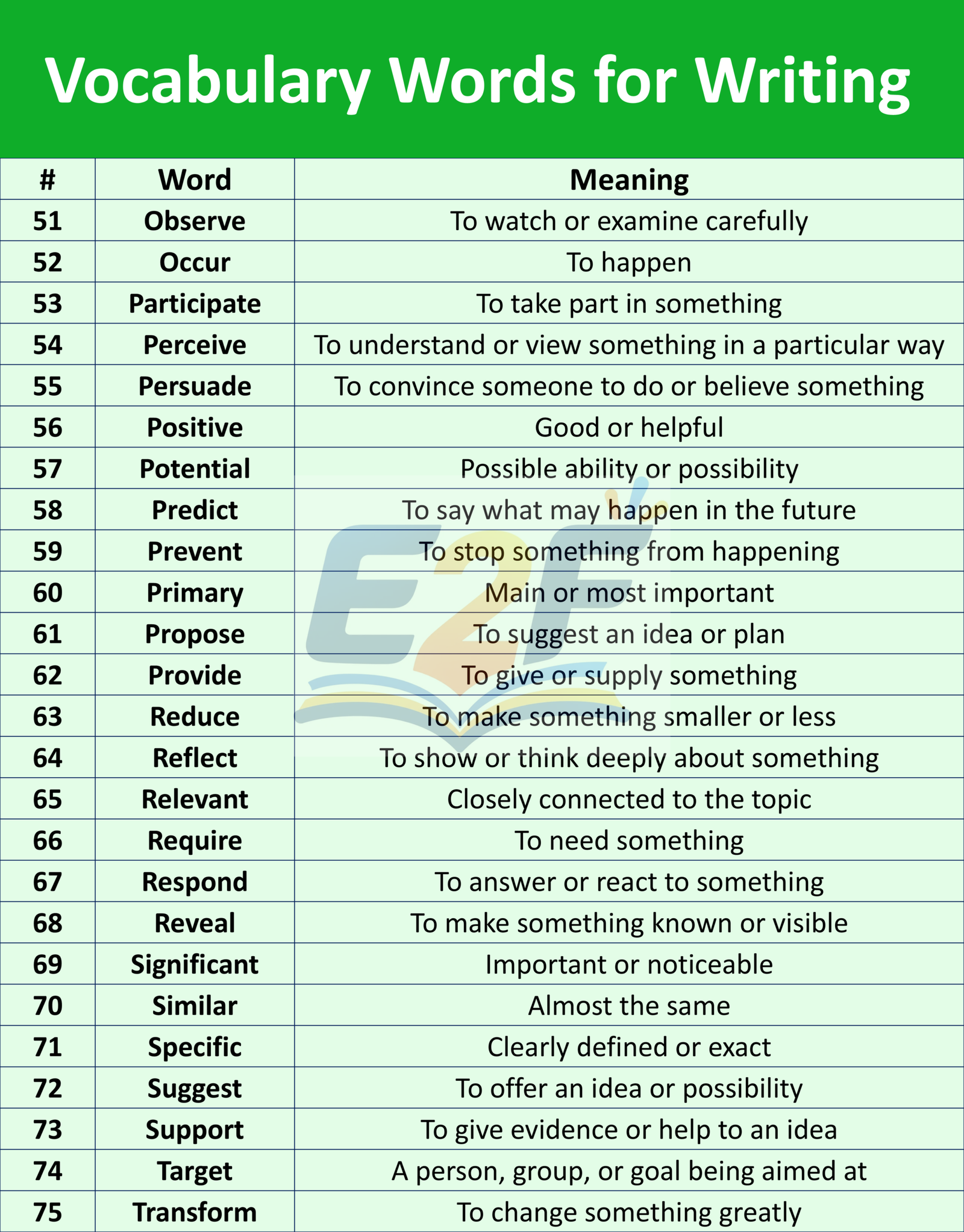
| 61 | Argue | To give reasons supporting an opinion | The writer argues that schools should encourage daily reading. |
| 62 | Convince | To make someone believe something | The evidence convinced the readers that the proposal was practical. |
| 63 | Persuade | To convince someone to believe or do something | The writer tries to persuade readers to reduce plastic waste. |
| 64 | Evidence | Information that supports an idea or claim | The writer uses evidence to support the main argument. |
| 65 | Support | To provide evidence or reasons for an idea | Several examples support the writer’s opinion. |
| 66 | Suggest | To present an idea or possibility | The findings suggest that reading regularly improves vocabulary. |
| 67 | Propose | To suggest a plan or idea | The student proposes a new solution to the problem. |
| 68 | Consider | To think carefully about something | Writers should consider different opinions before forming a conclusion. |
| 69 | Approach | A particular way of dealing with something | This approach gives students more opportunities to practice writing. |
| 70 | Target | The person or group that something is intended for | The article targets students who are learning English as a second language. |
Vocabulary Words for Stories and Descriptive Writing
These words help show time, movement, sequence, feelings, and changes in narrative or descriptive writing.
| # | Word | Meaning | Useful Sentence for Writing |
|---|---|---|---|
| 71 | Suddenly | Quickly and unexpectedly | Suddenly, the lights went out across the entire building. |
| 72 | Gradually | Slowly over a period of time | Gradually, the small village became a busy town. |
| 73 | Eventually | In the end, after some time | Eventually, the traveler reached the village before sunset. |
| 74 | Fortunately | Luckily | Fortunately, the family found a safe place before the storm began. |
| 75 | Meanwhile | At the same time | Meanwhile, the children waited quietly near the entrance. |
| 76 | Carefully | With attention and caution | She carefully opened the old wooden box. |
| 77 | Immediately | At once; without delay | He immediately noticed something unusual in the room. |
| 78 | Quietly | With little or no noise | The children quietly entered the empty classroom. |
| 79 | Unexpectedly | In a way that was not expected | Unexpectedly, the missing letter appeared beneath the door. |
| 80 | Transform | To change something greatly | The experience transformed the way she viewed her surroundings. |
Vocabulary Words for Conclusions and Summaries in Writing
A conclusion should bring the main idea together instead of simply repeating the introduction.
| # | Word | Meaning | Useful Sentence for Writing |
|---|---|---|---|
| 81 | Overall | Considering everything | Overall, the results show that regular practice is helpful. |
| 82 | Finally | At the end | Finally, the writer presents a practical solution to the problem. |
| 83 | Ultimately | In the end | Ultimately, successful writing depends on clear communication. |
| 84 | Conclude | To reach a final opinion or decision | We can conclude that both methods have advantages. |
| 85 | Summarize | To give the main points briefly | The final paragraph summarizes the main findings of the study. |
| 86 | Reflect | To show or express something | The student’s writing reflects a clear understanding of the topic. |
| 87 | Achieve | To successfully reach a goal | Students can achieve better results through regular writing practice. |
| 88 | Improve | To make something better | Feedback can help students improve their written work. |
| 89 | Maintain | To keep something at the same level or condition | Writers should maintain a clear focus throughout the essay. |
| 90 | Require | To need something | Strong academic writing requires careful organization and evidence. |
Useful General Writing Vocabulary
The final group contains versatile words that can work across essays, paragraphs, reports, stories, and other types of writing.
| # | Word | Meaning | Useful Sentence for Writing |
|---|---|---|---|
| 91 | Create | To make something new | Writers create stronger paragraphs by connecting related ideas. |
| 92 | Explain | To make an idea clear | The writer explains the main concept with a clear example. |
| 93 | Focus | To give attention to something | The essay focuses on the importance of environmental education. |
| 94 | Generate | To produce or create something | The discussion generated several possible solutions. |
| 95 | Involve | To include someone or something | The project involves students from several different classes. |
| 96 | Obtain | To get or receive something | Researchers obtained useful information from the survey. |
| 97 | Participate | To take part in something | Students participated in a writing activity during the lesson. |
| 98 | Perceive | To understand or view something in a particular way | Different readers may perceive the same character differently. |
| 99 | Vary | To be different or change | Sentence length should vary to make writing more natural. |
| 100 | Useful | Helpful or practical | A useful example can make a difficult idea easier to understand. |
How to Choose the Right Vocabulary for Writing
Having a large vocabulary does not automatically make writing better. The best word is the one that communicates your meaning accurately.
Before using a new word, ask:
- Does it express exactly what I mean?
- Does it fit the sentence and topic?
- Is it appropriate for my audience?
- Do I understand its meaning and grammar?
- Would a more familiar word communicate the idea better?
For example, obtain and get can have similar meanings, but they are not always equally natural.
The researcher obtained the results from the experiment.
In a casual conversation, got may sound more natural. In formal academic writing, obtained can be a better choice.
Common Vocabulary Mistakes
Using advanced words incorrectly can make writing less clear. Watch for these common problems:
- Then vs. than: Then relates to time; than is used for comparisons.
- Affect vs. effect: Affect is usually a verb; effect is usually a noun.
- Their vs. there vs. they’re: These words have different meanings and uses.
- Because vs. therefore: Because introduces a reason; therefore introduces a result.
- Compliment vs. complement: A compliment is praise; a complement completes or matches something.
Do not choose a word simply because it sounds more advanced. Correct and natural vocabulary is more valuable than complicated vocabulary.
Practice: Choose the Best Word
Choose the word that best completes each sentence.
- The study ________ that regular reading improves vocabulary.
(suggests / suddenly) - The writer used strong ________ to support the argument.
(evidence / meanwhile) - The two answers are ________, but they are not exactly the same.
(similar / finally) - The teacher asked students to ________ the two characters.
(compare / obtain) - The road was closed; ________, we took another route.
(therefore / although) - Good planning can ________ many common mistakes.
(prevent / describe) - The article ________ the main causes of pollution.
(explores / rarely) - The student ________ her explanation by adding an example.
(expanded / declined)
Answers:
- suggests
- evidence
- similar
- compare
- therefore
- prevent
- explores
- expanded
How to Build a Stronger Writing Vocabulary
You do not need to memorize 100 words at once. A better approach is to learn words in context and use them repeatedly.
Try these habits:
- Learn 5–10 words at a time.
- Write your own sentence for each new word.
- Group words by purpose, such as contrast, cause, description, and opinion.
- Read short English articles and notice how writers use vocabulary.
- Replace repeated words only when the new word has the correct meaning.
- Review older vocabulary regularly.
- Keep a personal vocabulary list with meanings and examples.
For example, instead of learning analyze as an isolated word, learn it in a sentence:
Students analyze the information before reaching a conclusion.
This makes it easier to remember both the meaning and the way the word works in a sentence.
FAQs About Vocabulary Words for Writing
What are the best vocabulary words to use in writing? – Useful writing vocabulary includes words such as analyze, demonstrate, explain, compare, contrast, support, relevant, significant, therefore, and ultimately.
How can I improve my English vocabulary for writing? – Read regularly, learn words in context, record useful vocabulary, write your own sentences, and review new words often.
What vocabulary makes writing sound better? – Precise words such as accurate, effective, relevant, significant, demonstrate, evaluate, and establish can make writing clearer and more specific.
Should I use difficult words in my writing? – No. Choose words that accurately express your meaning and fit your audience instead of using difficult vocabulary unnecessarily.
What are good vocabulary words for essays? – Useful essay vocabulary includes analyze, compare, contrast, evidence, support, demonstrate, however, therefore, consequently, and conclude.
How many new vocabulary words should I learn each day? – Learning five to ten useful words each day is a manageable approach, especially when you practice using them in your own sentences.
How can I avoid repeating the same words in writing? – Learn synonyms and related expressions, but replace repeated words only when the alternative has the same meaning and fits the context.
Which vocabulary words help with formal writing? – Words such as demonstrate, evaluate, establish, obtain, indicate, significant, relevant, consequently, and therefore are often useful in formal writing.
Conclusion
Learning vocabulary words to use in writing can help you express ideas with greater accuracy, variety, and confidence. You do not need to use complicated words to become a better writer. Focus on understanding each word, learning how it works in a sentence, and choosing vocabulary that fits your meaning.
Start with a small group of words from this list, use them in your own sentences, and gradually add more. With regular reading and writing practice, your English vocabulary will become more flexible and useful across essays, school assignments, stories, and everyday communication.
