100 English Vocabulary Words with Meanings and Sentences
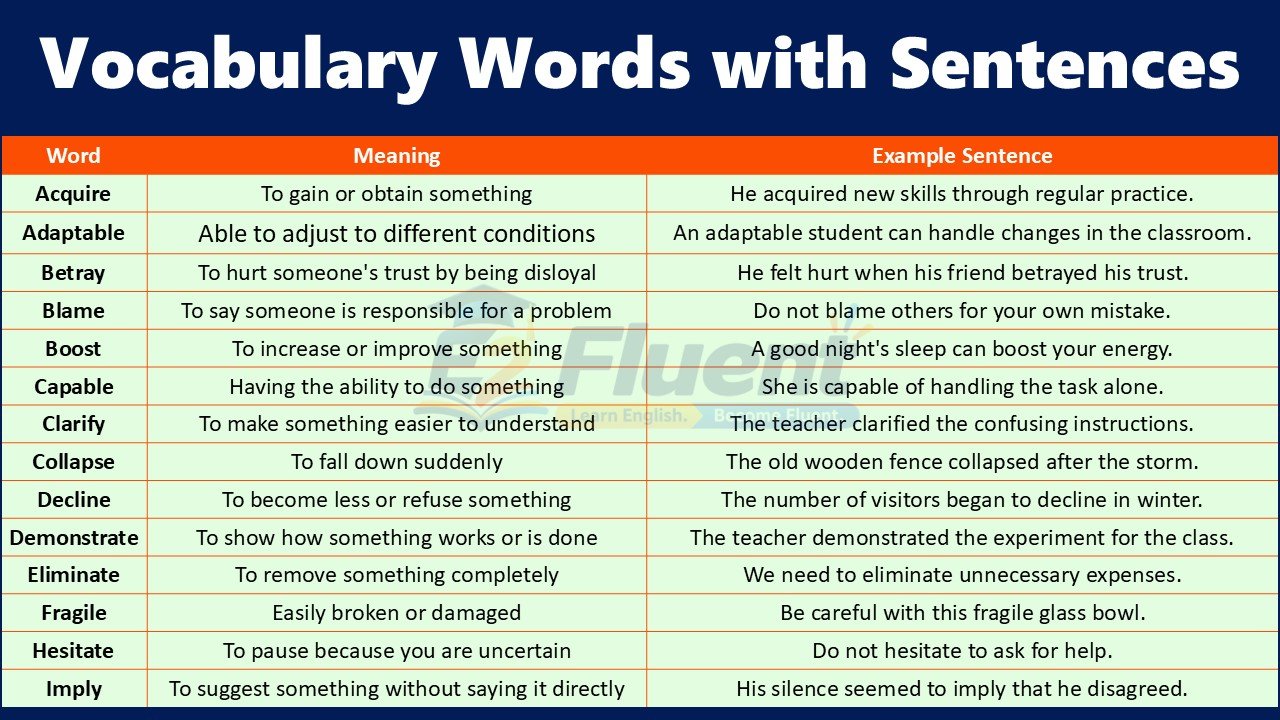
Building a strong English vocabulary requires learning words with their meanings, correct usage, and real sentence examples. These 100 vocabulary words include useful English terms with clear definitions and natural example sentences that show how each word works in context. The list covers words used to describe people, actions, ideas, situations, qualities, and everyday communication. Learning each word through a sentence helps you understand its meaning more accurately and use it correctly when speaking and writing English.
English Vocabulary Words with Meanings and Examples
| No. | Word | Meaning | Example Sentence |
|---|---|---|---|
| 1 | Abundant | Existing in large quantities | Fresh fruit is abundant during the summer season. |
| 2 | Accuse | To say that someone did something wrong | The teacher did not accuse anyone without evidence. |
| 3 | Acknowledge | To accept or recognize something as true | She acknowledged her mistake and apologized. |
| 4 | Acquire | To gain or obtain something | He acquired new skills through regular practice. |
| 5 | Adaptable | Able to adjust to different conditions | An adaptable student can handle changes in the classroom. |
| 6 | Ambitious | Having a strong desire to achieve something | The ambitious student hopes to become a scientist. |
| 7 | Anticipate | To expect something before it happens | We anticipate heavy traffic during the holiday. |
| 8 | Approach | To move closer to something or someone | The train began to approach the station. |
| 9 | Arise | To happen or begin to exist | Several questions arose during the discussion. |
| 10 | Assist | To help someone with a task | The nurse assisted the doctor during the examination. |
| 11 | Attempt | An effort to do or achieve something | Her first attempt at painting was successful. |
| 12 | Attain | To succeed in reaching a goal | He worked hard to attain his academic goals. |
| 13 | Avoid | To stay away from something | Try to avoid unnecessary arguments. |
| 14 | Betray | To hurt someone’s trust by being disloyal | He felt hurt when his friend betrayed his trust. |
| 15 | Blame | To say someone is responsible for a problem | Do not blame others for your own mistake. |
| 16 | Boost | To increase or improve something | A good night’s sleep can boost your energy. |
| 17 | Capable | Having the ability to do something | She is capable of handling the task alone. |
| 18 | Clarify | To make something easier to understand | The teacher clarified the confusing instructions. |
| 19 | Collapse | To fall down suddenly | The old wooden fence collapsed after the storm. |
| 20 | Compassion | Concern for someone who is suffering | The nurse treated every patient with compassion. |
| 21 | Competent | Having enough skill to do something well | The mechanic is competent and experienced. |
| 22 | Conclude | To reach a decision after thinking | The committee concluded that the plan needed changes. |
| 23 | Conduct | To organize and carry out an activity | The researchers conducted several tests. |
| 24 | Confuse | To make someone unable to understand clearly | The similar names confused the students. |
| 25 | Consistent | Doing something in the same reliable way | Consistent practice helped her improve her pronunciation. |
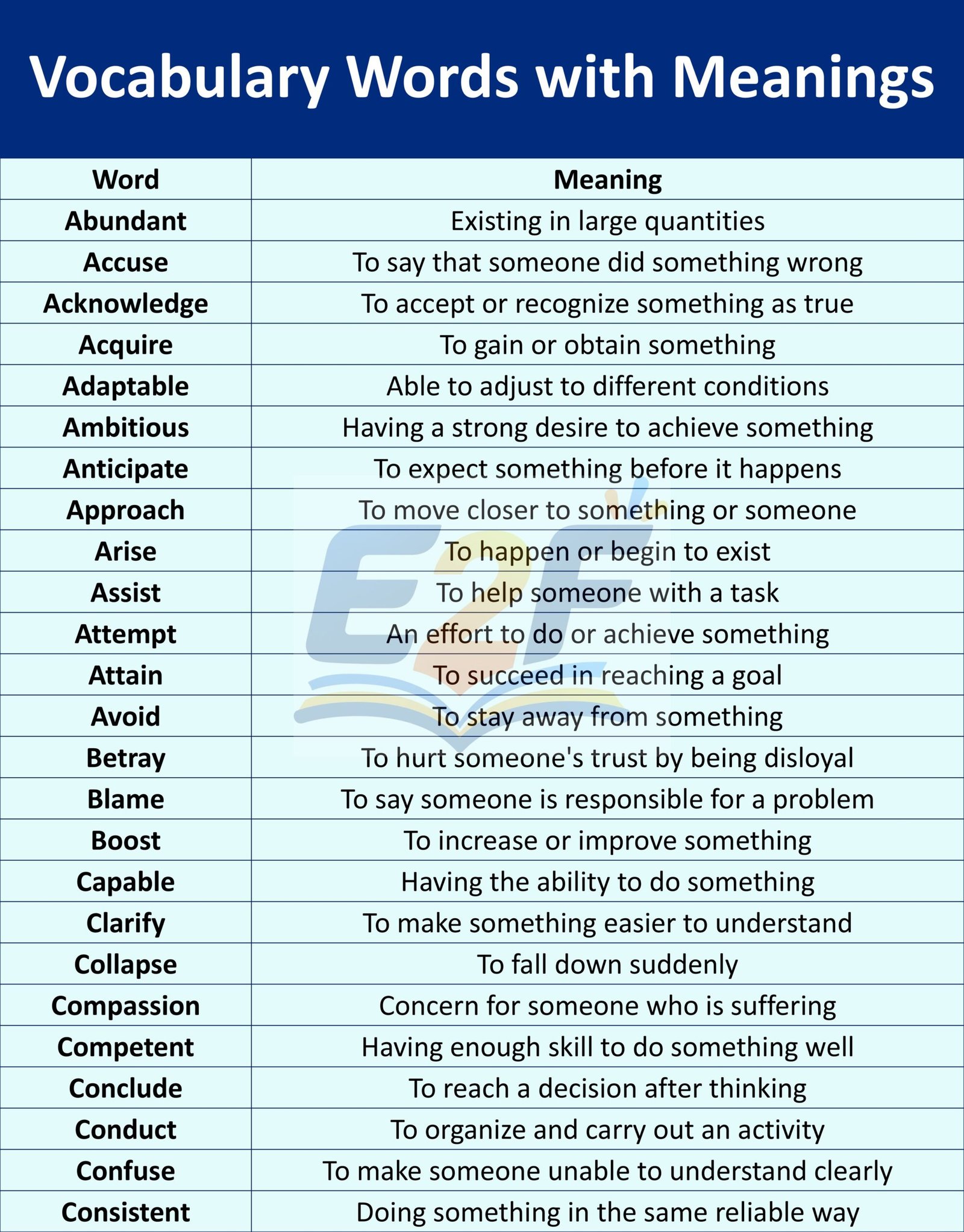
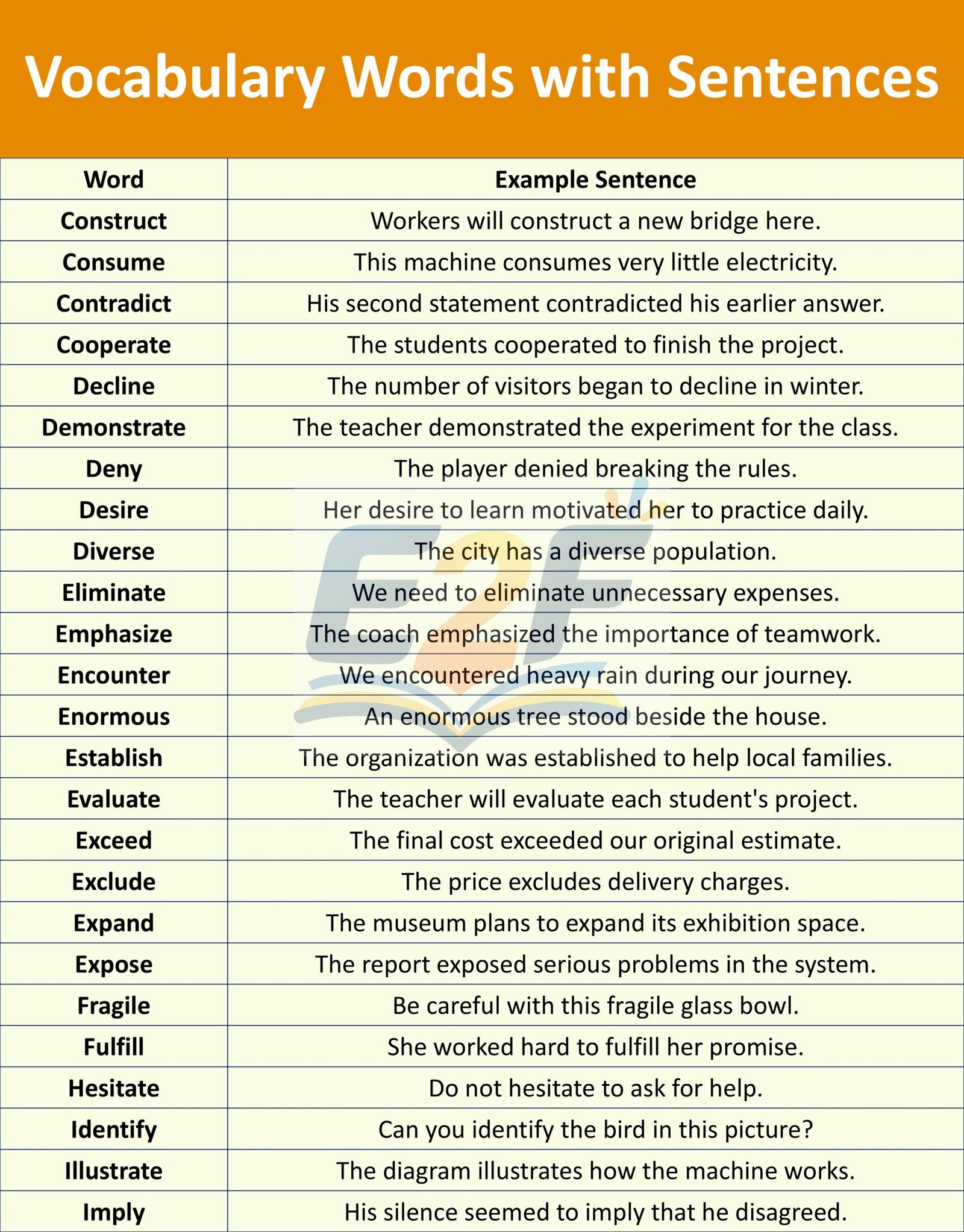
Vocabulary Words with Definitions and Sentences
| No. | Word | Meaning | Example Sentence |
|---|---|---|---|
| 26 | Construct | To build something | Workers will construct a new bridge here. |
| 27 | Consume | To eat, drink, or use something | This machine consumes very little electricity. |
| 28 | Contradict | To say the opposite of what someone else says | His second statement contradicted his earlier answer. |
| 29 | Cooperate | To work together toward a shared result | The students cooperated to finish the project. |
| 30 | Decline | To become less or refuse something | The number of visitors began to decline in winter. |
| 31 | Demonstrate | To show how something works or is done | The teacher demonstrated the experiment for the class. |
| 32 | Deny | To say that something is not true | The player denied breaking the rules. |
| 33 | Desire | A strong wish to have or do something | Her desire to learn motivated her to practice daily. |
| 34 | Diverse | Including many different types of people or things | The city has a diverse population. |
| 35 | Eliminate | To remove something completely | We need to eliminate unnecessary expenses. |
| 36 | Emphasize | To give special importance to something | The coach emphasized the importance of teamwork. |
| 37 | Encounter | To meet or experience something unexpectedly | We encountered heavy rain during our journey. |
| 38 | Enormous | Extremely large in size or amount | An enormous tree stood beside the house. |
| 39 | Establish | To create or set up something | The organization was established to help local families. |
| 40 | Evaluate | To judge the quality or value of something | The teacher will evaluate each student’s project. |
| 41 | Exceed | To go beyond a particular amount or limit | The final cost exceeded our original estimate. |
| 42 | Exclude | To leave someone or something out | The price excludes delivery charges. |
| 43 | Expand | To become larger or increase in scope | The museum plans to expand its exhibition space. |
| 44 | Expose | To make something visible or known | The report exposed serious problems in the system. |
| 45 | Fragile | Easily broken or damaged | Be careful with this fragile glass bowl. |
| 46 | Fulfill | To complete or achieve something expected | She worked hard to fulfill her promise. |
| 47 | Hesitate | To pause because you are uncertain | Do not hesitate to ask for help. |
| 48 | Identify | To recognize or name someone or something | Can you identify the bird in this picture? |
| 49 | Illustrate | To explain something using an example or picture | The diagram illustrates how the machine works. |
| 50 | Imply | To suggest something without saying it directly | His silence seemed to imply that he disagreed. |
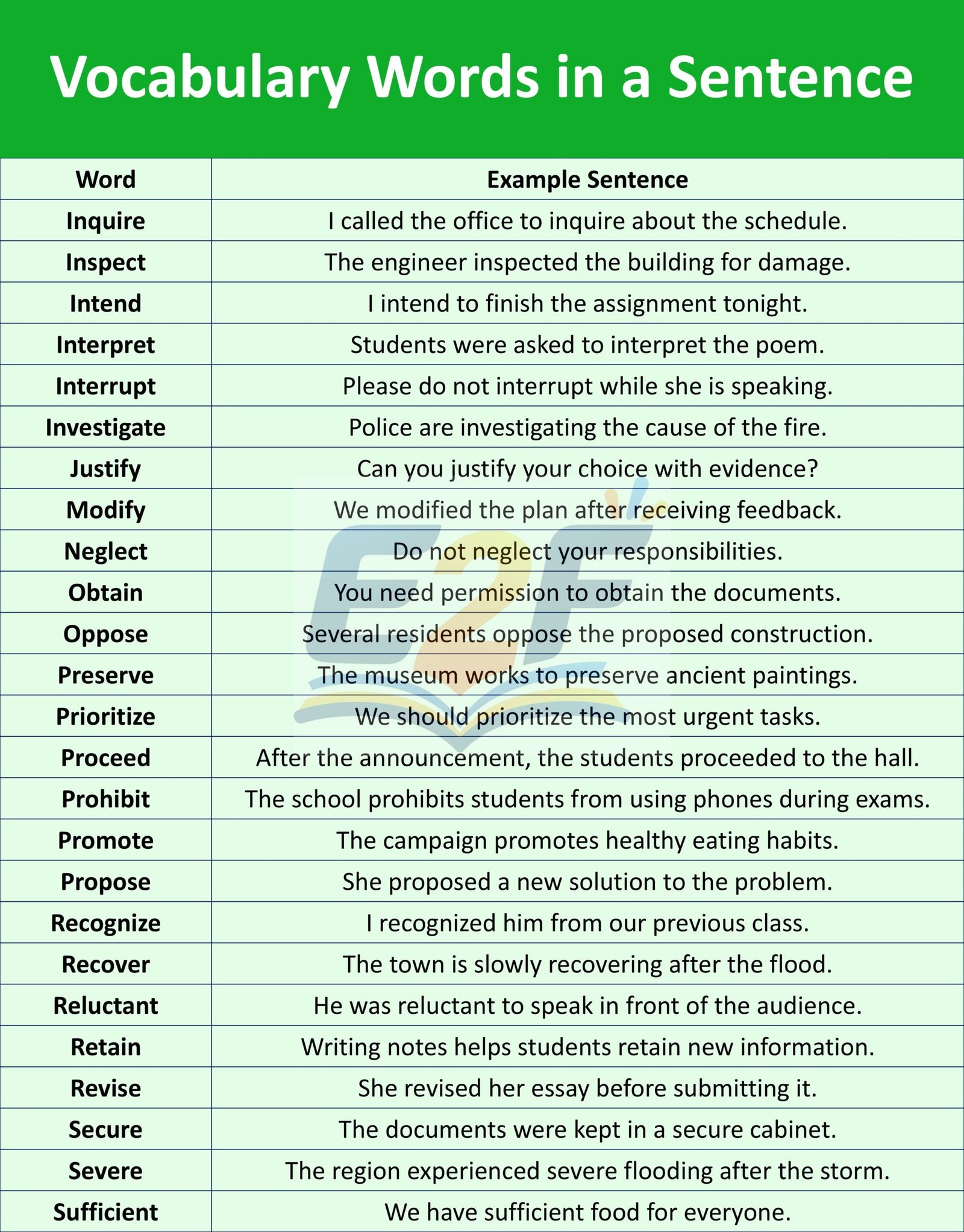
English Words with Meanings and Sentences
| No. | Word | Meaning | Example Sentence |
|---|---|---|---|
| 51 | Inquire | To ask for information | I called the office to inquire about the schedule. |
| 52 | Inspect | To check something carefully | The engineer inspected the building for damage. |
| 53 | Intend | To plan or mean to do something | I intend to finish the assignment tonight. |
| 54 | Interpret | To explain the meaning of something | Students were asked to interpret the poem. |
| 55 | Interrupt | To stop someone while they are speaking or doing something | Please do not interrupt while she is speaking. |
| 56 | Investigate | To examine something to discover facts | Police are investigating the cause of the fire. |
| 57 | Justify | To give a good reason for something | Can you justify your choice with evidence? |
| 58 | Modify | To change something slightly | We modified the plan after receiving feedback. |
| 59 | Neglect | To fail to give proper care or attention | Do not neglect your responsibilities. |
| 60 | Obtain | To get something through effort or action | You need permission to obtain the documents. |
| 61 | Oppose | To disagree with or resist something | Several residents oppose the proposed construction. |
| 62 | Preserve | To protect something from damage or decay | The museum works to preserve ancient paintings. |
| 63 | Prioritize | To decide what should receive attention first | We should prioritize the most urgent tasks. |
| 64 | Proceed | To continue after stopping or preparing | After the announcement, the students proceeded to the hall. |
| 65 | Prohibit | To officially stop something from being allowed | The school prohibits students from using phones during exams. |
| 66 | Promote | To encourage or support the growth of something | The campaign promotes healthy eating habits. |
| 67 | Propose | To suggest an idea or plan | She proposed a new solution to the problem. |
| 68 | Recognize | To know someone or something because you have seen it before | I recognized him from our previous class. |
| 69 | Recover | To return to a normal condition after difficulty | The town is slowly recovering after the flood. |
| 70 | Reluctant | Not willing or eager to do something | He was reluctant to speak in front of the audience. |
| 71 | Retain | To keep something instead of losing it | Writing notes helps students retain new information. |
| 72 | Revise | To change something to improve it | She revised her essay before submitting it. |
| 73 | Secure | Safe or protected from danger | The documents were kept in a secure cabinet. |
| 74 | Severe | Very serious or intense | The region experienced severe flooding after the storm. |
| 75 | Sufficient | Enough for a particular purpose | We have sufficient food for everyone. |
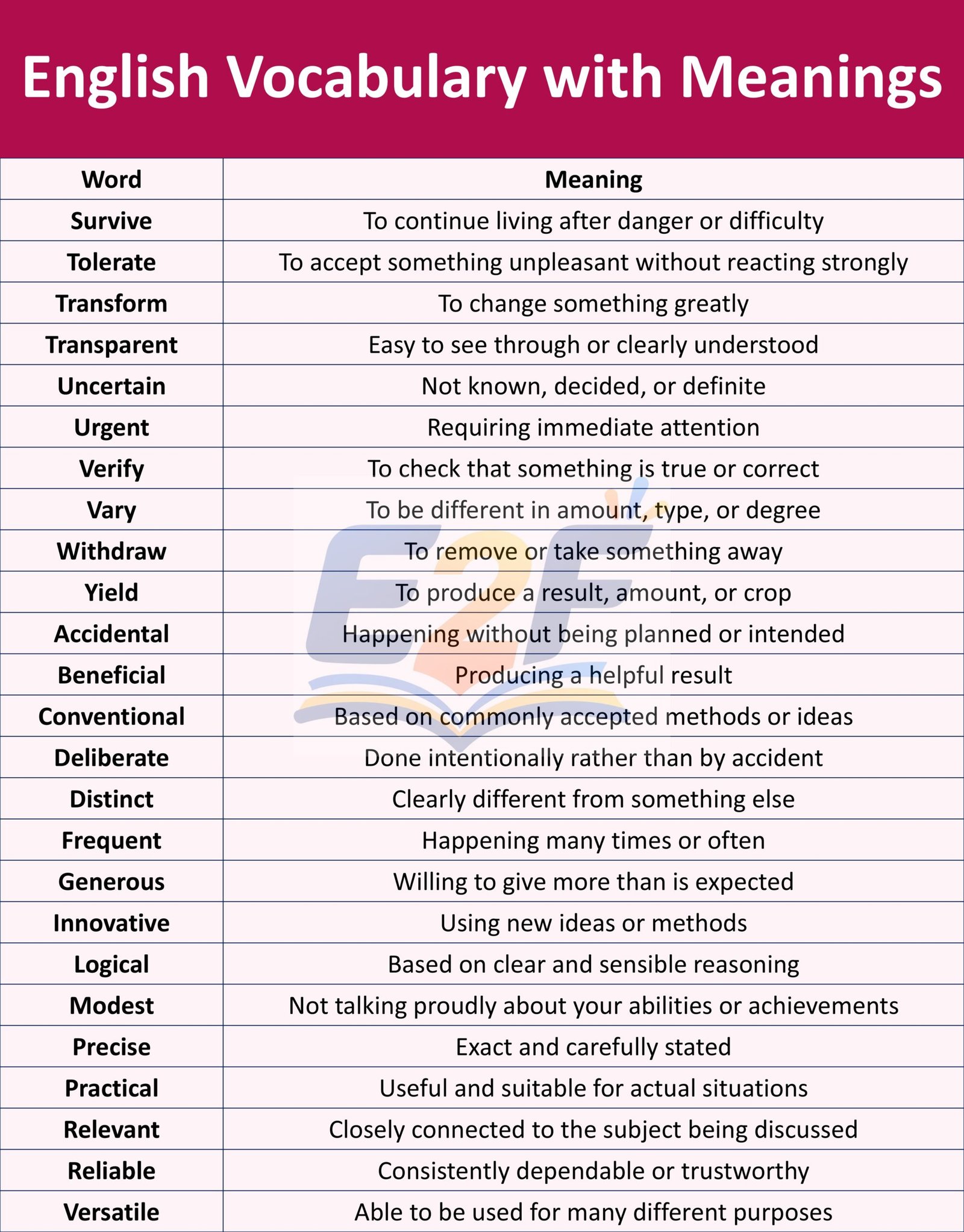
Words with Meanings and Example Sentences
| No. | Word | Meaning | Example Sentence |
|---|---|---|---|
| 76 | Survive | To continue living after danger or difficulty | Some plants can survive with very little water. |
| 77 | Tolerate | To accept something unpleasant without reacting strongly | I cannot tolerate loud noise while studying. |
| 78 | Transform | To change something greatly | The renovation transformed the old building. |
| 79 | Transparent | Easy to see through or clearly understood | The company promised a transparent hiring process. |
| 80 | Uncertain | Not known, decided, or definite | The date of the meeting is still uncertain. |
| 81 | Urgent | Requiring immediate attention | The doctor said that the treatment was urgent. |
| 82 | Verify | To check that something is true or correct | Please verify the information before publishing it. |
| 83 | Vary | To be different in amount, type, or degree | Prices vary depending on the season. |
| 84 | Withdraw | To remove or take something away | He decided to withdraw his application. |
| 85 | Yield | To produce a result, amount, or crop | The farm yielded a large crop of wheat. |
| 86 | Accidental | Happening without being planned or intended | The broken window was the result of an accidental hit. |
| 87 | Beneficial | Producing a helpful result | Regular reading is beneficial for language development. |
| 88 | Conventional | Based on commonly accepted methods or ideas | They chose a conventional design for the new building. |
| 89 | Deliberate | Done intentionally rather than by accident | The damage was deliberate, not accidental. |
| 90 | Distinct | Clearly different from something else | The two birds have distinct patterns on their wings. |
| 91 | Frequent | Happening many times or often | Frequent breaks can help you stay focused while studying. |
| 92 | Generous | Willing to give more than is expected | The generous donor provided books for the entire school. |
| 93 | Innovative | Using new ideas or methods | The company developed an innovative way to recycle plastic. |
| 94 | Logical | Based on clear and sensible reasoning | Her explanation was logical and easy to follow. |
| 95 | Modest | Not talking proudly about your abilities or achievements | Despite winning the award, he remained modest. |
| 96 | Precise | Exact and carefully stated | The scientist recorded precise measurements. |
| 97 | Practical | Useful and suitable for actual situations | These practical tips can help you manage your time. |
| 98 | Relevant | Closely connected to the subject being discussed | Please include only relevant information in your answer. |
| 99 | Reliable | Consistently dependable or trustworthy | We need a reliable source for this information. |
| 100 | Versatile | Able to be used for many different purposes | A tablet is a versatile device for studying and reading. |
How to Use These Vocabulary Words
Learning a word becomes easier when you connect its meaning with its use in a sentence.
For each word:
- Read the word aloud.
- Read its meaning carefully.
- Read the example sentence.
- Identify how the word works in the sentence.
- Create your own sentence.
- Review the word again later.
For example:
Word: Encourage
Meaning: To give someone support or confidence
Example: Good teachers encourage students to ask questions.
Your sentence: My parents encourage me to read every day.
This approach helps you connect the vocabulary with meaning, grammar, and context.
Vocabulary Words in a Sentence
A word can have different meanings depending on how it is used. The sentence around the word helps you understand its intended meaning.
1. Patient
As an adjective: Able to wait calmly.
The teacher was patient with the new students.
As a noun: A person receiving medical care.
The doctor spoke with the patient.
The spelling is the same, but the meaning changes according to the context.
2. Support
As a verb: To help someone.
My friends support my decision.
As a noun: Help or encouragement.
Her family gave her strong support.
3. Increase
As a verb: To become greater.
Food prices continue to increase.
As a noun: A rise in amount or size.
There was an increase in food prices.
4. Complete
As an adjective: Having all parts; finished.
The project is complete.
As a verb: To finish something.
Please complete the project today.
5. Respect
As a noun: A feeling of admiration or regard.
He has great respect for his coach.
As a verb: To treat someone with proper regard.
We should respect other people’s opinions.
Vocabulary Words with Examples by Word Type
Knowing the word type can help you build correct sentences.
| Word Type | Examples | Example |
|---|---|---|
| Noun | knowledge, kindness, effort | Her knowledge of English is growing. |
| Verb | improve, discover, solve | We solve problems together. |
| Adjective | brave, honest, useful | She is an honest person. |
| Adverb | carefully, quickly, slowly | He completed the task carefully. |
The 100 words above include mainly nouns, verbs, and adjectives. Recognizing their grammatical role helps you use them correctly.
Useful Synonyms for Vocabulary Practice
Learning related words can expand your vocabulary without memorizing unrelated lists.
| Word | Useful Synonym |
|---|---|
| Accurate | Correct |
| Admire | Respect |
| Brave | Courageous |
| Calm | Peaceful |
| Combine | Join |
| Encourage | Support |
| Entire | Whole |
| Genuine | Real |
| Grateful | Thankful |
| Honest | Truthful |
| Improve | Develop |
| Intelligent | Smart |
| Maintain | Preserve |
| Rare | Uncommon |
| Reliable | Trustworthy |
| Require | Need |
| Significant | Important |
| Similar | Alike |
| Unique | Special |
| Useful | Helpful |
A synonym may be close in meaning but not always interchangeable. Always check the sentence and situation before replacing one word with another.
Practice: Complete the Sentences
Choose the vocabulary word that best completes each sentence.
- Please ______ your answer before submitting the test.
- The children were ______ to learn about the planets.
- We should ______ the amount of water we waste.
- My parents always ______ me when I face difficulties.
- The scientist carefully ______ the experiment.
- She remained ______ during the emergency.
- This dictionary is very ______ for English learners.
- The teacher asked everyone to ______ in the discussion.
- We need to ______ the problem before Friday.
- He is a ______ worker who always finishes his tasks.
Word Bank:
accurate, eager, reduce, support, observed, calm, useful, participate, solve, reliable
Answer Key:
- accurate
- eager
- reduce
- support
- observed
- calm
- useful
- participate
- solve
- reliable
FAQs
What are vocabulary words?
Vocabulary words are words that a person knows and understands and can use when speaking, reading, listening, or writing.
How can I learn vocabulary words faster?
Read each word in context, understand its meaning, say it aloud, write your own sentence, and review it regularly.
Why are example sentences important for vocabulary?
Example sentences show how a word works in context, making its meaning, grammar, and natural usage easier to understand.
How many vocabulary words should I learn each day?
Learning 5–10 words thoroughly is often more useful than memorizing a large list without practicing their meanings and usage.
How can I use new vocabulary in speaking? – Choose a few new words, create sentences about familiar situations, and use those sentences during everyday conversations.
Should I learn vocabulary with meanings or sentences?
Learn both. The meaning tells you what a word means, while the example sentence shows how to use it correctly.
What are the best vocabulary words for English learners?
Useful words include common verbs, adjectives, nouns, and academic terms that frequently appear in conversations, reading, schoolwork, and writing.
Conclusion
Building a strong vocabulary takes more than memorizing definitions. Learning Vocabulary Words with Meanings and Sentences helps you understand each word and see how it works in context.
Start with a few words at a time. Read the examples, write your own sentences, and review the words regularly. With consistent practice, new English words become easier to recognize, remember, and use.
You May Also Like: